
A hand-crank hose reel mounting bracket holds the reel on the wall, the post, or the cart, and the bracket decides how much of the yard the hose can reach. The reel is useless if the bracket sags, pulls out of the siding, or holds the reel at an angle that fights the crank. The bracket is the small steel part that carries the full weight of the reel and the water inside it.
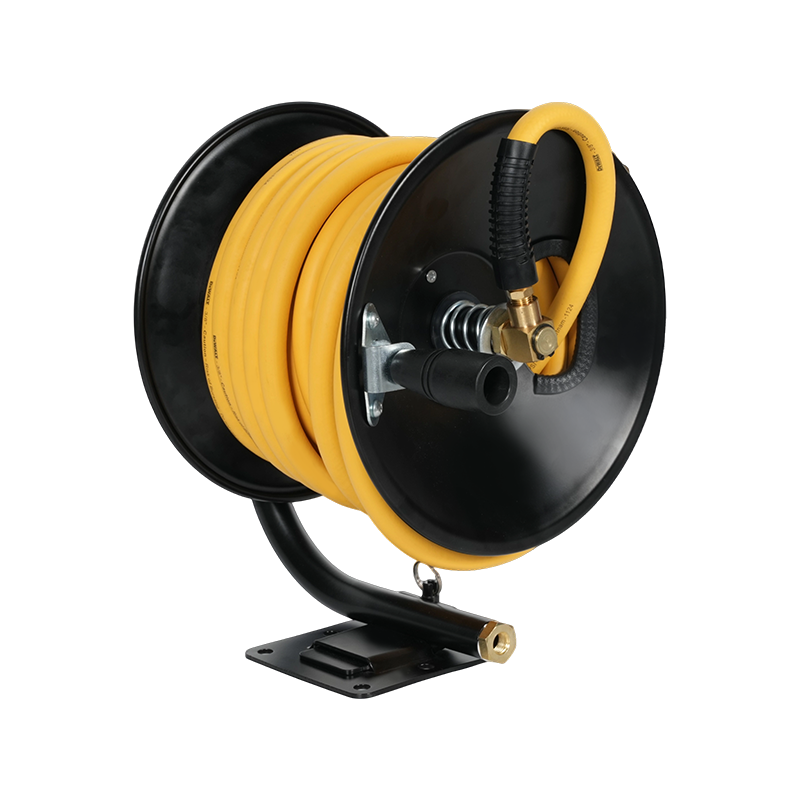
A fifty-foot hose, filled with water, weighs more than most people expect. The bracket carries that load in the static condition and the extra load when the hose is pulled. The steel gauge and the mounting pattern decide whether the bracket holds.
A bracket with the thick mounting plate and the full-perimeter weld at the arm holds the loaded reel. A stamped bracket with the spot welds bends at the arm on the first hard pull.
The bracket has to attach to the material behind it. Wood siding takes the lag screws. Brick and block take the sleeve anchors. Vinyl siding needs the blocking behind it, or the bracket pulls through the panel.
A hand-crank hose reel mounting bracket with the mounting holes spaced for the stud or the blocking distributes the load into the structure. The bracket with the single center hole concentrates the load and the fastener pulls out.
The bracket holds the reel at the height and the angle that suits the yard. The higher mount reaches more of the space but the reel is harder to crank. The lower mount is easier to use but the hose drags.
A hand-crank hose reel mounting bracket with the pivot or the adjustable arm lets the user set the angle for the crank and the hose path. The fixed bracket forces the compromise.
The bracket has to hold the reel far enough off the wall for the crank handle to turn. The bracket that mounts the reel too close to the wall leaves the knuckles scraping the siding on every turn.
The bracket lives outdoors. The powder coat over the phosphate-treated steel resists the rust at the welds and the mounting holes. The bare steel bracket rusts at the fastener and stains the siding.
What the factory has to deliver:
The side wall of the garage holds the reel for the front yard. The post in the garden holds it for the back. The cart bracket lets the reel move with the work. The bracket that suits the surface and the reach is the one that gets installed.
The bracket is only as good as the fastener and the blocking behind it. A heavy bracket on a hollow wall fails at the wall. The buyer who checks the stud location before the drill touches the siding is the buyer who does not see the reel on the ground.

We sincerely welcome domestic and international customers to visit us and discuss cooperation opportunities!

ykjg@wenlide.com
ykxy@wenlide.com

86-0579-89266926
86-0579-87353489

+86-13735620288
+86-15258987461
+86-13566910892

No. 299, Quanhu Indsutrial Zone, Shizhu Town, Yongkang City, Zhejiang Province, China
Copyright © Yongkang XiangYe Tools Manufacturing Co., Ltd. All Rights Reserved.
Hand Trucks and Transport Trolley Manufacturer



 English
 中文简体