
A stack of boxes blocks the hallway. A pile of luggage sits at the curb. A load of trade show equipment needs to move from the van to the booth. A handheld folding cart luggage trolley unfolds in seconds, carries the load on a small platform, and folds back down to something that fits in a backpack or a glove box. It is not a shopping cart. It is not a luggage trolley with a tall frame. It is a simple load carrier, a platform on wheels with a handle, designed to disappear when not in use. Here is what hardware retailers, promotional product distributors, and logistics buyers should know about the cart that punches above its weight.
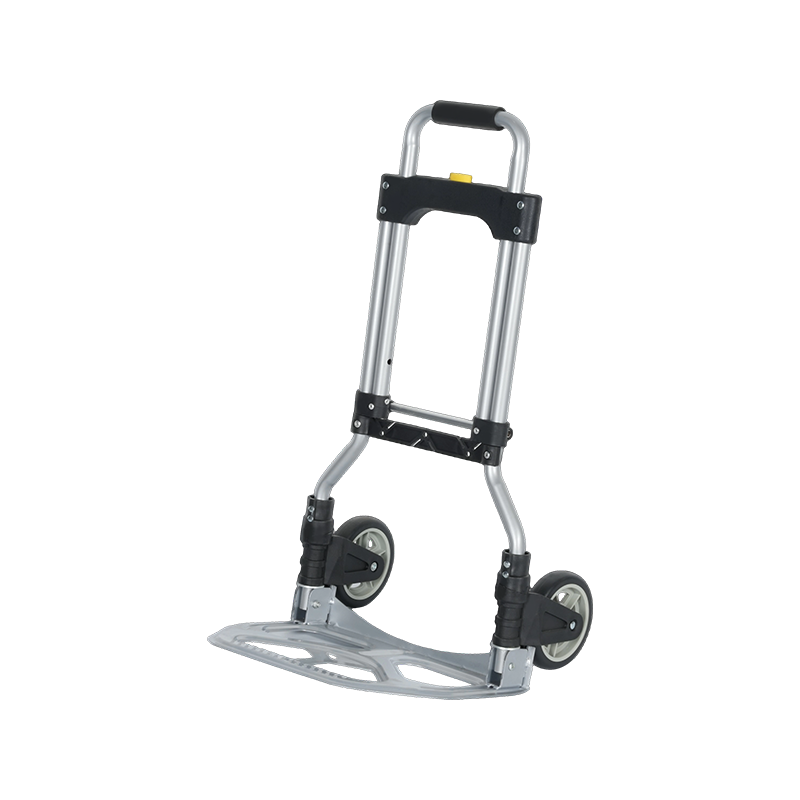
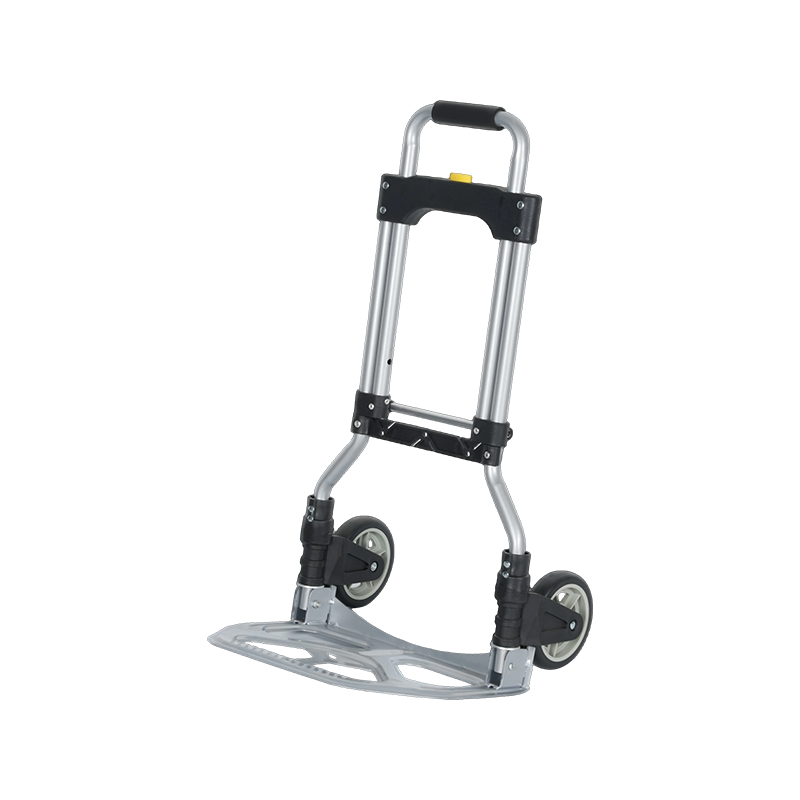
The platform is the heart of the cart. It is typically a flat plate or a folded metal tray that hinges down from the handle frame. When open, it holds boxes, bags, or cases. When closed, it folds up against the handle shaft. A handheld folding cart luggage trolley platform built from stamped aluminum or reinforced plastic balances weight capacity against the overall cart weight. Steel platforms handle more load but make the cart heavier to carry when folded.
Platform size determines what fits. A platform that is too small tips a tall stack of boxes sideways. A platform that is too wide makes the folded cart bulky. The standard folding cart platform measures roughly 30 by 25 centimeters, large enough to support a moving box or two medium suitcases. A handheld folding cart luggage trolley with an extendable platform lip adds a few extra centimeters of support for larger items.
The hinge between the platform and the frame takes the full load as a bending moment. A handheld folding cart luggage trolley with a reinforced hinge, thick pin, and wide bearing surface holds the platform flat under load without sagging. A hinge that bends under weight lets the platform tilt forward and dump the cargo.
Wheel size and material determine where the cart can go. Small hard plastic wheels work on smooth airport floors and hotel lobbies. They struggle on pavement, carpet, and gravel. A handheld folding cart luggage trolley with rubber or polyurethane tread and a wheel diameter of at least 75 millimeters rolls over sidewalk cracks and door thresholds without jamming.
The axle mounting takes impact every time the cart hits a bump. A handheld folding cart luggage trolley with axles bolted through the frame or mounted in steel brackets holds wheel alignment. Axles pressed into plastic housings work loose and wobble.
Wheel spacing affects stability. Wheels mounted wider apart resist tipping when the load is tall or unevenly packed. A handheld folding cart luggage trolley with wheels positioned near the outer edges of the platform footprint keeps the load upright through turns and over bumps.
The handle provides the leverage to tilt the load back and roll it. A telescoping handle extends to a comfortable height for pulling and retracts for storage. A handheld folding cart luggage trolley with a locking telescoping handle that stays put at the set height prevents the handle from collapsing mid-pull.
The folding mechanism converts the cart from a load carrier to a handheld bundle. A typical design folds the platform up against the handle shaft, then the handle folds down or telescopes in. A handheld folding cart luggage trolley that folds to roughly the size of a thick textbook fits in a backpack, a briefcase, or a car door pocket. The folded package should have a securing strap or latch so it does not spring open during transport.
The grip at the top of the handle takes the pull force. A handheld folding cart luggage trolley with a contoured foam or rubber grip reduces hand fatigue during long pulls through airports or convention centers. A bare plastic or metal grip gets uncomfortable after a few minutes.
Here is what a folding cart built for real loads needs:
Travelers use folding carts to move luggage from the curb to the check-in counter when airport trolleys are nowhere in sight. A handheld folding cart luggage trolley packed in a suitcase deploys at the destination for the same job in reverse.
Office and facility staff use them to move boxes of paper, shipments of supplies, or catering orders from the loading dock to the break room. A handheld folding cart luggage trolley stored in a supply closet replaces a full-size hand truck for small moves.
Trade show exhibitors and sales reps carry folding carts in their vehicle for moving samples, displays, and literature from the parking lot to the booth. A handheld folding cart luggage trolley that deploys fast and folds away clean keeps the focus on the meeting, not on the logistics.
The hinge pin shears or bends under load. A handheld folding cart luggage trolley with an undersized pin or a soft metal hinge deforms the first time it is overloaded. The platform no longer folds flat or locks open.
The wheels develop flat spots from sitting loaded in one position. A handheld folding cart luggage trolley with polyurethane wheels resists flat-spotting better than soft rubber. Flat-spotted wheels thump and vibrate with every rotation.
A handheld folding cart luggage trolley is a simple machine. A platform. Two wheels. A handle. It carries luggage, boxes, and supplies from point A to point B, then folds into something that fits on a shelf. Choose a cart with a solid hinge, wheels that roll on real surfaces, and a handle that locks. The load moves. The cart disappears. That is the design.


We sincerely welcome domestic and international customers to visit us and discuss cooperation opportunities!

ykjg@wenlide.com
ykxy@wenlide.com

86-0579-89266926
86-0579-87353489

+86-13735620288
+86-15258987461
+86-13566910892

No. 299, Quanhu Indsutrial Zone, Shizhu Town, Yongkang City, Zhejiang Province, China
Copyright © Yongkang XiangYe Tools Manufacturing Co., Ltd. All Rights Reserved.
Hand Trucks and Transport Trolley Manufacturer



 English
 中文简体
中文简体